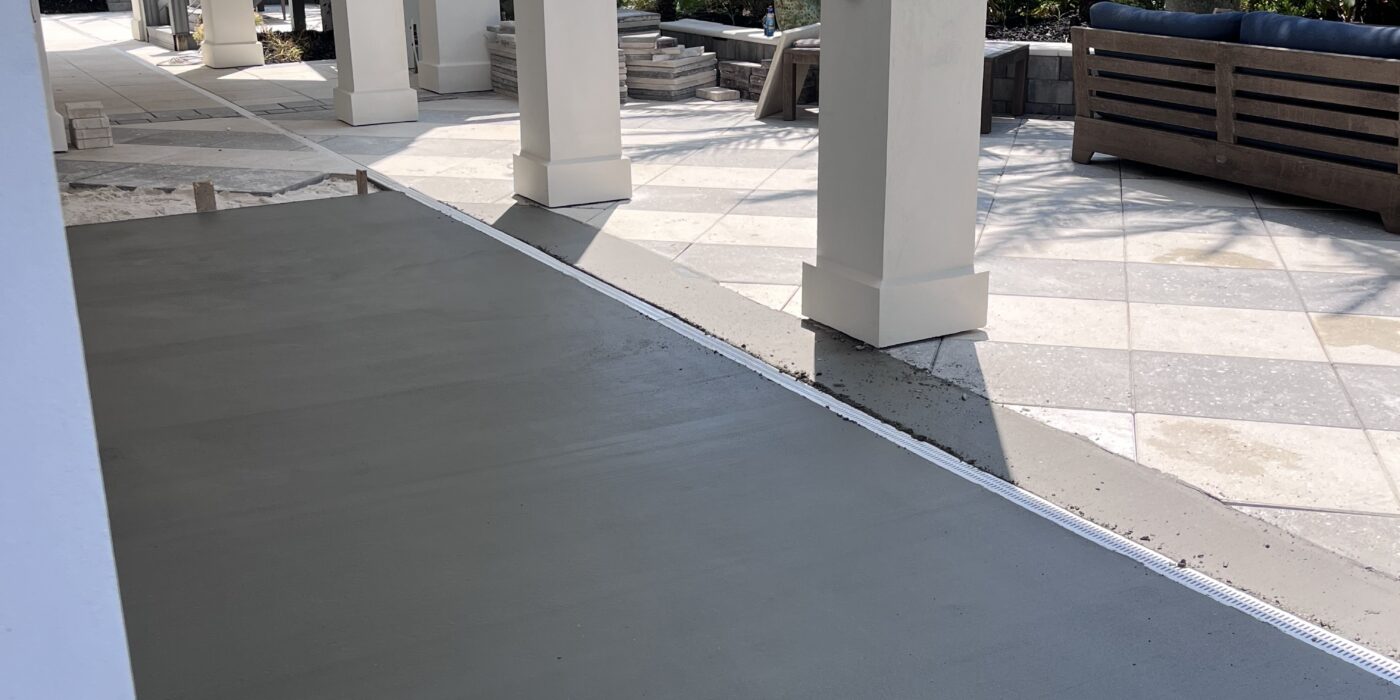
A patio is the cheapest square footage you will ever add to a house. It is also the slab people spend the most time actually looking at, so the finish and the layout matter as much as what is underneath.
Laying the patio out before anything is poured
The layout is worth more thought than most people give it. How far the roofline shades it in the afternoon, where the door swings, whether a table and chairs actually fit once you allow room to pull a chair back, where the grill goes and whether there is a hose bib within reach — these are the things that decide whether a patio gets used.
We mark the outline on the ground before pouring so you can walk it, put a chair on it and change your mind while changing your mind is still free.
Finishes and how they behave underfoot
A broom finish is the standard for outdoor slabs and the one we recommend most often: it gives grip when the surface is wet, hides marks and costs nothing extra. A smooth trowel finish looks sharper but turns slick in the rain, which is worth knowing before choosing it for a patio that catches the afternoon storms.
Where you want pattern or colour, stamped concrete gives the look of stone, brick or plank without the joints and weeds of pavers. Salt finish and exposed aggregate sit between the two — more texture than a trowel, more interest than a broom.
Drainage, and why the slope is not optional
A patio against the house has to shed water away from the foundation. The usual fall is around a quarter inch per foot — enough to move water, not enough to feel like a slope when you are standing on it or to rock a table.
It matters more here than in a drier climate. A summer downpour can drop a couple of inches in an hour, and a patio poured flat, or worse, back toward the slab, holds that water against the house every single time.
What every job includes
- Outline marked on the ground for you to walk before the pour
- Broom, smooth, salt or stamped finish
- Sloped roughly a quarter inch per foot away from the house
- Tied cleanly into existing slabs, steps and door thresholds
- Control joints placed to suit the shape, not just the square footage
Areas we serve
Steve’s Concrete LLC covers Pensacola, FL and the communities below. If your address is nearby but not on the list, call and ask — it is usually a yes.
- Pensacola
- Gulf Breeze
- Navarre
- Pace
- Milton
- Perdido Key
- Cantonment
- Bellview
- Escambia County
- Santa Rosa County
Patios: common questions
A broom finish, in most cases. It keeps its grip when wet, which matters in a climate with daily summer storms, and it hides scuffs and stains better than a smooth trowel. Choose a smooth finish only for a covered patio that stays dry.
Four inches over a compacted base is right for a patio carrying furniture and people. There is no need to go thicker unless something heavy will live on it — an outdoor kitchen, a hot tub or a large fire feature all need the slab thickened and reinforced under them.
Sometimes, but it is usually the wrong call. An overlay follows every crack and settlement in the slab underneath, and it raises the finished height, which can put the patio above a door threshold. Where the existing slab is sound we will say so; where it is not, tear-out is the cheaper answer over any real timeframe.