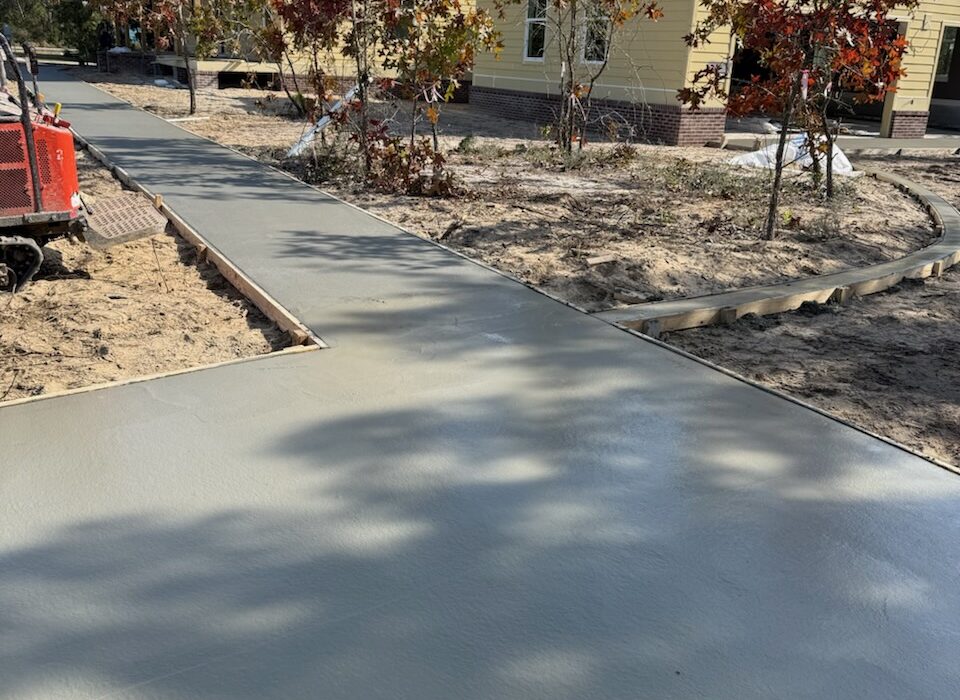
Shop floors, garage pads, shed and workshop slabs, equipment bases, generator and AC pads, dumpster pads and parking aprons. Different jobs, same question every time: how much load, on what ground, and how flat does the finished surface need to be.
Sizing the slab to what will sit on it
A garden shed and a shop with a two-post lift in it are not the same slab. Four inches over a compacted base is right for a shed, a workshop floor or a carport. Six inches with rebar on a grid is where you go for a lift, a heavy trailer, farm equipment or anything that will see a loaded truck.
Point loads change the answer again. A post frame building, a lift base or a piece of standing equipment gets the slab thickened locally under it rather than the whole pour taken up a size, which is usually both stronger where it matters and cheaper overall.
Flatness, and finishing for the surface that goes on top
How flat a slab needs to be depends entirely on what happens to it next. A shop floor that will be swept and driven on gets a hard steel trowel finish — dense, smooth and easy to clean. A slab taking tile or an epoxy coating is floated and finished to suit that coating, because both will telegraph a bad surface.
Outdoor slabs get a broom finish for grip, and they get slope. A shed pad or an equipment pad poured dead flat sits in standing water after every storm.
Thickened edges, joints and vapour barriers
A slab supporting walls gets a thickened edge or a turned-down footing under the bearing lines. An interior slab that will be conditioned space, or take a floor covering, goes over a vapour barrier — without one, ground moisture comes up through the concrete and lifts adhesives and coatings months later.
Joints are laid out to the shape of the slab. Panels are kept roughly square, joints run through re-entrant corners where cracks want to start anyway, and isolation joints keep the slab free of columns and walls so the two can move independently.
What every job includes
- Garage, shop, shed, carport and equipment slabs
- Four inches standard; six with rebar for lifts and heavy loads
- Thickened edges under bearing walls and point loads
- Steel trowel, broom or coating-ready finish as the job needs
- Vapour barrier under conditioned and covered slabs
- Isolation joints at columns, walls and existing slabs
Areas we serve
Steve’s Concrete LLC covers Pensacola, FL and the communities below. If your address is nearby but not on the list, call and ask — it is usually a yes.
- Pensacola
- Gulf Breeze
- Navarre
- Pace
- Milton
- Perdido Key
- Cantonment
- Bellview
- Escambia County
- Santa Rosa County
Concrete Slabs: common questions
Four inches over a compacted base covers a normal garage or workshop floor. Six inches with rebar on a grid is the answer where a car lift, farm equipment, a loaded trailer or a delivery truck will be on it. Under a lift base or a post specifically, the slab is thickened locally rather than the whole pour taken up.
Under anything that will be conditioned space, or that will take tile, epoxy or any glued-down floor covering, yes. Ground moisture moves up through concrete continuously and will lift a coating or an adhesive months after it went down. An open carport or an outdoor equipment pad does not need one.
Yes, and the building supplier's drawings are the starting point. They set the finished dimensions, where the anchor points fall and whether the edge needs thickening under the frame. Bring those to the estimate and the slab gets formed to the building rather than the building shimmed to the slab.