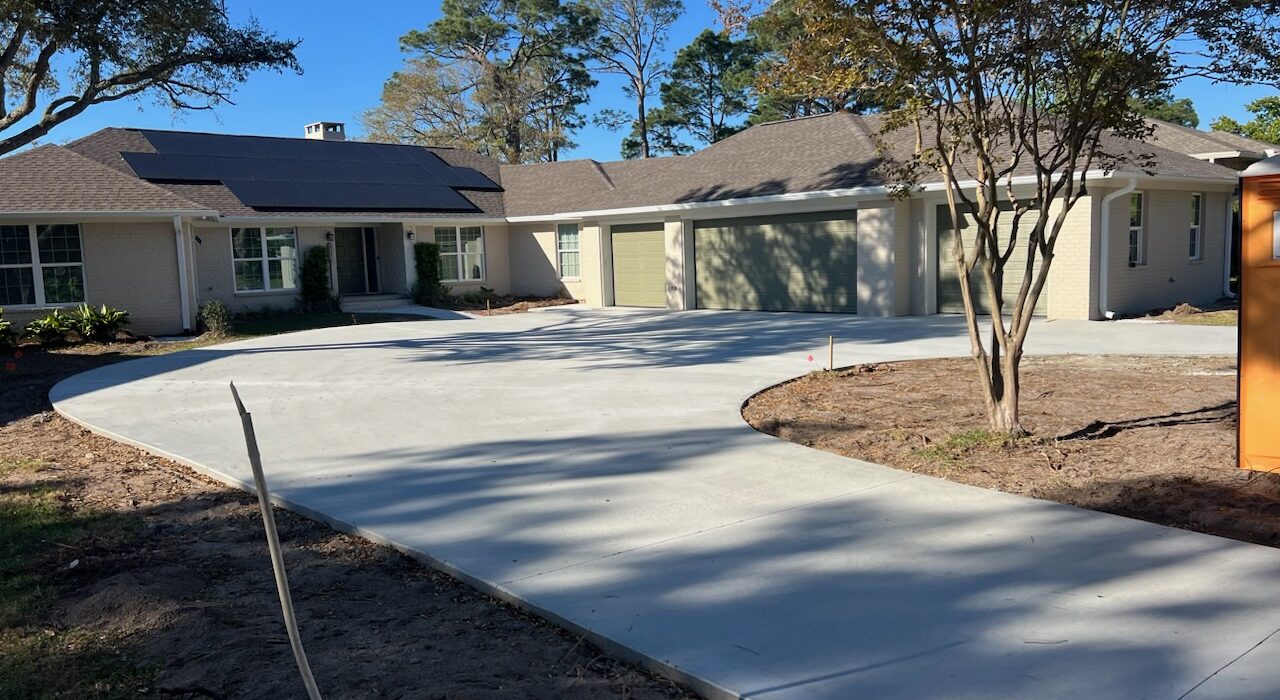
A concrete driveway is the first thing anyone sees and the piece of your property that takes the most abuse. Done properly it outlasts the car parked on it. Done cheaply it cracks, settles at the apron and starts breaking up at the edges within a few seasons.
What goes into a driveway that lasts
Most driveway failures are prep failures, not concrete failures. The sandy subgrade common across the Panhandle drains well but moves under load if it is not compacted, and a slab poured over soft fill will crack along whatever line the ground gives way on.
Every driveway starts with the base: strip the topsoil and organics, bring the grade up with compactable fill where it is needed, and compact it in lifts rather than all at once. Forms go in to the finished grade so water runs off the slab and away from the house, not toward the garage door. Reinforcement — fibre, mesh or rebar depending on the span and what will be parked on it — goes in before any concrete arrives.
Thickness, reinforcement and control joints
A residential driveway carrying cars and a light truck is normally poured at four inches. Where an RV, a boat trailer, a work truck or a delivery vehicle will sit on it, that goes up — usually to five or six inches with heavier reinforcement, and the apron where vehicles turn in off the road gets the same treatment.
Concrete shrinks as it cures, and it will crack. Control joints decide where. They are cut to roughly a quarter of the slab depth and spaced so no panel is much longer than about two and a half times its width, which keeps the cracking down inside the joint where nobody sees it. Skipping joints, or cutting them too late or too shallow, is the single most common reason a new driveway ends up with a random crack across it.
Replacing an existing driveway
Tear-out and replacement is usually the honest answer when a driveway has settled unevenly, has cracks wide enough to catch a shoe, or has started spalling across the surface. Patching buys a season or two and rarely matches.
A new driveway normally needs a permit. Removing an existing driveway and replacing it in the same footprint normally does not. Requirements differ between Escambia County, Santa Rosa County and the city jurisdictions inside them, so we confirm what your address needs before the job is scheduled rather than after. We handle the demolition and haul-off, and the site is left graded and swept rather than covered in broken slab.
What every job includes
- Topsoil and organics stripped, base compacted in lifts
- Four inches standard; five to six for RV, boat and truck parking
- Fibre, mesh or rebar sized to the span and the load
- Control joints cut to depth and spaced to the panel size
- Graded so water runs away from the house and garage
- Old driveway demolition and haul-off included
Areas we serve
Steve’s Concrete LLC covers Pensacola, FL and the communities below. If your address is nearby but not on the list, call and ask — it is usually a yes.
- Pensacola
- Gulf Breeze
- Navarre
- Pace
- Milton
- Perdido Key
- Cantonment
- Bellview
- Escambia County
- Santa Rosa County
Driveways: common questions
Walk on it after about 24 hours. Cars after seven days. Heavy vehicles — an RV, a loaded trailer, a delivery truck — after 28 days, which is when concrete reaches its rated strength. Driving on it early is the fastest way to crack a slab that would otherwise have been fine.
Four inches over a properly compacted base handles normal car and light truck traffic. Go to five or six inches, with heavier reinforcement, wherever an RV, boat trailer or work truck will park or turn. Thickness only helps if the base under it is right — six inches over soft fill will still crack.
A new driveway normally requires a permit. Replacing an existing one in the same footprint normally does not. Requirements vary between Escambia County, Santa Rosa County and the cities within them, and anything that changes the width, the apron or where the driveway meets the road counts as new work. We check what your address needs as part of the estimate.
Every concrete slab cracks as it cures — that is the material, not a defect. The job of the installer is to decide where. Control joints cut to the right depth and spacing put those cracks inside a straight line you barely notice instead of across the middle of the slab.